
Guide · Nov 3, 2026
Watermelon and Lycopene: How Much Is in a Cup?
A cup of diced watermelon has about 6.9 mg of lycopene, more than a cup of raw tomato. Here's how variety, flesh color and storage change that number, with USDA data.
By Michael Gonzales · Last updated
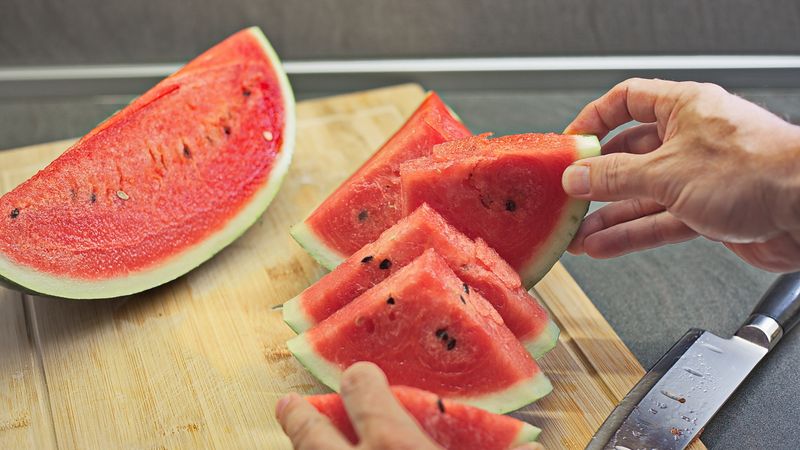
Short answer: One cup of diced watermelon (152 g) has about 6.9 mg of lycopene, based on USDA data of 4.5 mg per 100 grams [1]. That's more than a cup of chopped raw tomato, which has about 4.6 mg [1]. A big wedge, about 1/16 of a melon, has roughly 13 mg [1].
Those are averages. Lycopene in watermelon varies a lot by variety, flesh color and even how you store the melon before you cut it. Here's what the numbers look like and what changes them.
ProstateFoods shares general information about food and research. It isn't medical advice, and nothing here is meant to diagnose, treat or prevent any disease. Talk with your doctor about your own diet.
How much lycopene is in a cup of watermelon?
USDA FoodData Central lists raw watermelon at 4,532 micrograms (about 4.5 mg) of lycopene per 100 grams [1]. Here's what that works out to for common portions.
| Portion | Weight | Lycopene | Calories |
|---|---|---|---|
| 10 melon balls | 122 g | 5.5 mg | 37 |
| 1 cup diced | 152 g | 6.9 mg | 46 |
| 1 cup melon balls | 154 g | 7.0 mg | 46 |
| 1 wedge (about 1/16 of a melon) | 286 g | 13.0 mg | 86 |
Source: USDA FoodData Central, watermelon, raw (FDC 167765) [1]. Lycopene and calories calculated from the per-100 g values and USDA portion weights.
Watermelon is about 91% water, and a cup has about 46 calories [1]. That's a lot of lycopene for very few calories.
Does watermelon have more lycopene than tomatoes?
Than raw tomatoes, yes. Than cooked tomato products, no.
| Food | Portion | Lycopene |
|---|---|---|
| Watermelon, raw | 1 cup diced (152 g) | 6.9 mg |
| Tomato, raw | 1 cup chopped (180 g) | 4.6 mg |
| Tomato, raw | 1 medium (123 g) | 3.2 mg |
| Tomato paste, no salt added | 1 tablespoon (16 g) | 4.6 mg |
Source: USDA FoodData Central, FDC 167765, 170457 and 170459 [1].
Per 100 grams, watermelon has about 4.5 mg and raw tomato about 2.6 mg. Tomato paste is far more concentrated, at about 28.8 mg per 100 grams [1]. For the full list, see our guide to foods high in lycopene.
Why does lycopene vary so much between melons?
Variety. A USDA Agricultural Research Service study measured 50 red-fleshed watermelon cultivars. Lycopene ranged from 33 to 100 mg per kilogram [2]. On a 152 g cup, that's roughly 5 to 15 mg. The USDA database figure of 4.5 mg per 100 g sits toward the low end of that range [1][2].
Seedless vs seeded. In the same study, most seeded hybrid varieties had average lycopene. Sixteen of the 33 seedless types fell in the high or very high groups [2]. So seedless melons aren't lower in lycopene, and many tested higher.
Flesh color. Lycopene is what makes the flesh red. Genetic research describes red-fleshed watermelons as the high-lycopene type and yellow or orange ones as low-lycopene [3]. If lycopene is why you're buying it, pick red.
Does storing watermelon change the lycopene?
It can, before you cut it. USDA researchers stored whole watermelons for 14 days at different temperatures and compared them with fresh fruit [4]:
| Storage temperature | Change in lycopene after 14 days |
|---|---|
| 21°C (about 70°F, room temperature) | Up 11% to 40% |
| 13°C (about 55°F) | Little change |
Source: Perkins-Veazie and Collins, Journal of Agricultural and Food Chemistry, 2006 [4].
So a whole, uncut melon can sit on the counter for a few days without losing lycopene. That changes once you cut it. The FDA says to refrigerate all pre-cut produce, and to buy cut watermelon only if it's refrigerated or on ice [5].
How should you cut and store watermelon?
The FDA's produce safety advice applies to melons [5]:
- Wash the outside first. Scrub firm produce like melons with a clean produce brush under running water, even though you won't eat the rind. Otherwise, the knife carries dirt and bacteria from the rind into the flesh. Don't use soap or produce wash.
- Use a clean board. Keep produce separate from raw meat, poultry and seafood. Use a different board for each if you can.
- Refrigerate cut pieces. Store them at 40°F or below.
A whole melon is big and slippery, so a large board that catches juice helps. The OXO Good Grips Carving & Cutting Board is about 14 by 21 inches, with a drip-catcher, non-slip feet and a non-porous surface. The FDA says non-porous boards can go through the dishwasher after use [5]. For the cut cubes, a lidded, airtight container such as the Rubbermaid Brilliance 9.6-cup food storage container keeps them sealed in the fridge.
Does your body absorb lycopene from watermelon?
Yes, at least from watermelon juice. In a USDA study, 23 healthy adults drank fresh-frozen watermelon juice for three weeks at a time, providing about 20 mg of lycopene a day [6]. Their blood lycopene rose to levels similar to a group drinking canned tomato juice with about 18 mg a day. That matters because tomato lycopene is usually absorbed best after cooking, and watermelon is eaten raw [6].
Doubling the watermelon juice dose to about 40 mg a day didn't raise blood lycopene any further by week three [6]. More isn't always more.
Is watermelon good for your prostate?
Research hasn't shown that. When the FDA reviewed lycopene and cancer risk, it found no credible evidence linking lycopene intake to lower prostate cancer risk [7]. That review covered lycopene in general, not watermelon specifically. Our page on lycopene and what the research says goes through those findings.
Watermelon is still a low-calorie fruit with a lot of water and some potassium and vitamin C [1]. For foods with more research behind them, see foods to eat for prostate health. If you want lycopene from cooked tomatoes, try our simple tomato sauce with olive oil.
Sources
- USDA FoodData Central, SR Legacy: Watermelon, raw (FDC 167765); Tomatoes, red, ripe, raw, year round average (FDC 170457); Tomato products, canned, paste, without salt added (FDC 170459)
- Perkins-Veazie P, Collins JK, Davis AR, Roberts W. Carotenoid content of 50 watermelon cultivars. J Agric Food Chem. 2006;54(7):2593-2597
- Subburaj S, et al. Whole genome resequencing of watermelons to identify single nucleotide polymorphisms related to flesh color and lycopene content. PLoS One. 2019;14(10):e0223441
- Perkins-Veazie P, Collins JK. Carotenoid changes of intact watermelons after storage. J Agric Food Chem. 2006;54(16):5868-5874
- U.S. Food and Drug Administration, Selecting and Serving Produce Safely
- Edwards AJ, et al. Consumption of watermelon juice increases plasma concentrations of lycopene and beta-carotene in humans. J Nutr. 2003;133(4):1043-1050
- Kavanaugh CJ, Trumbo PR, Ellwood KC. The U.S. Food and Drug Administration's evidence-based review for qualified health claims: tomatoes, lycopene, and cancer. J Natl Cancer Inst. 2007;99(14):1074-1085
Photo: Damir Mijailovic / Pexels
Frequently asked questions
How much lycopene is in 1 cup of watermelon?
About 6.9 mg in a cup of diced watermelon (152 g), based on USDA data of 4.5 mg per 100 grams.
Is there more lycopene in watermelon or tomatoes?
Raw watermelon has more than raw tomatoes: about 4.5 mg per 100 grams versus 2.6 mg. Tomato paste has far more, about 28.8 mg per 100 grams.
Do seedless watermelons have less lycopene?
No. In a USDA study of 50 cultivars, 16 of the 33 seedless types were in the high or very high lycopene groups.
Does yellow watermelon have lycopene?
Very little. Red-fleshed watermelons are the high-lycopene type, and yellow and orange types are low in lycopene.
Is watermelon good for your prostate?
There's no proof it is. The FDA found no credible evidence that lycopene intake lowers prostate cancer risk. Watermelon is a hydrating, low-calorie fruit, but no study has shown it protects the prostate.
Should you store watermelon in the fridge?
Cut watermelon, yes. The FDA says to refrigerate pre-cut produce at 40°F or below. In one USDA study, whole uncut melons kept at room temperature for two weeks gained lycopene.

Written by
Michael Gonzales
Founder & Editor
Michael Gonzales is the founder of Cloudalien Technologies LLC, the company that owns ProstateFoods, and he edits every page on the site. ProstateFoods publishes everyday recipes, food lists and grocery guides for men who want to eat well. Michael is not a doctor or registered dietitian, so nothing on ProstateFoods is medical advice.