
Guide · Oct 21, 2026
Foods High in Vitamin D: A Ranked List
21 foods ranked by vitamin D per serving from USDA data, from trout and salmon to UV-treated mushrooms and fortified milk, with % Daily Value.
By the ProstateFoods editorial team · Last updated
Short answer: The foods highest in vitamin D are cod liver oil, fatty fish like trout, salmon and mackerel, and mushrooms that have been exposed to UV light. A cooked 3-ounce serving of farmed rainbow trout has about 645 IU (16.2 mcg) of vitamin D, or 81% of the Daily Value, in USDA FoodData Central [1].
Very few foods have much vitamin D on their own. NIH's Office of Dietary Supplements notes that fortified foods such as milk and cereal supply most of the vitamin D in American diets [2]. So the list below is mostly fish, plus a few fortified drinks and one surprise from the produce aisle.
Vitamin D per serving: the ranked list
| # | Food | Serving | mcg | IU | % DV |
|---|---|---|---|---|---|
| 1 | Cod liver oil | 1 tbsp (13.6 g) | 34.0 | 1,360 | 170% |
| 2 | Rainbow trout, farmed, cooked | 3 oz (85 g) | 16.2 | 645 | 81% |
| 3 | Sockeye salmon, cooked | 3 oz (85 g) | 14.2 | 570 | 71% |
| 4 | Swordfish, cooked (high in mercury; see below) | 3 oz (85 g) | 14.1 | 566 | 71% |
| 5 | Pink salmon, canned, drained | 3 oz (85 g) | 12.3 | 493 | 62% |
| 6 | Atlantic salmon, farmed, cooked | 3 oz (85 g) | 11.1 | 447 | 56% |
| 7 | Mackerel, Pacific and jack, cooked | 3 oz (85 g) | 9.7 | 388 | 48% |
| 8 | White mushrooms, UV-exposed, raw, sliced | 1/2 cup (35 g) | 9.2 | 366 | 46% |
| 9 | Light tuna, canned in oil, drained | 3 oz (85 g) | 5.7 | 229 | 28% |
| 10 | Halibut, cooked | 3 oz (85 g) | 4.9 | 196 | 25% |
| 11 | Atlantic herring, cooked | 3 oz (85 g) | 4.6 | 182 | 23% |
| 12 | Sardines, Atlantic, canned in oil, drained | 1 can, 3.75 oz (92 g) | 4.4 | 178 | 22% |
| 13 | Tilapia, cooked | 1 fillet (87 g) | 3.2 | 130 | 16% |
| 14 | Milk, 2%, vitamin D fortified | 1 cup (244 g) | 2.9 | 120 | 15% |
| 15 | Almond milk, unsweetened, fortified | 1 cup (262 g) | 2.6 | 107 | 13% |
| 16 | Soy milk, fortified | 1 cup (243 g) | 2.7 | 104 | 13% |
| 17 | Orange juice, calcium and vitamin D fortified | 1 cup (249 g) | 2.5 | 100 | 12% |
| 18 | Albacore (white) tuna, canned in water | 3 oz (85 g) | 1.7 | 68 | 9% |
| 19 | Egg, hard-boiled | 1 large (50 g) | 1.1 | 44 | 6% |
| 20 | Beef liver, braised | 3 oz (85 g) | 1.0 | 42 | 5% |
| 21 | Cheddar cheese | 1 oz (28 g) | 0.3 | 11 | 1% |
Values are from USDA FoodData Central, SR Legacy, worked out per serving from USDA's per-100 g figures and portion weights [1]. % DV uses FDA's Daily Value of 20 mcg (800 IU) [2]. Foods are ranked by IU per serving. USDA rounds its mcg and IU figures separately, so a couple of close pairs look slightly out of order in the mcg column.
Fortified foods vary by brand, and some brands add none at all. The Nutrition Facts label lists vitamin D in mcg, so it's the number to trust for anything in a carton or box [2].
How much vitamin D do you need a day?
Adults need 600 IU (15 mcg) of vitamin D a day through age 70 and 800 IU (20 mcg) from age 71, according to the Recommended Dietary Allowances in NIH's vitamin D fact sheet [2]. The upper limit for adults is 4,000 IU (100 mcg) a day from food, drinks and supplements combined [2].
| Who | Daily amount | Upper limit |
|---|---|---|
| Adults 19 to 70 | 600 IU (15 mcg) | 4,000 IU (100 mcg) |
| Adults 71 and older | 800 IU (20 mcg) | 4,000 IU (100 mcg) |
| Food label Daily Value | 800 IU (20 mcg) | - |
One mcg of vitamin D equals 40 IU [2]. The Daily Value on labels is a single reference number, not a personal target, so a food with 25% DV has about 200 IU.
Which fish has the most vitamin D?
Farmed rainbow trout tops the fish in USDA data, with about 645 IU per cooked 3 ounces. Sockeye salmon (570 IU) and swordfish (566 IU) come next, then canned pink salmon (493 IU) and farmed Atlantic salmon (447 IU) [1].
One catch: swordfish is on the FDA and EPA "choices to avoid" list because it has some of the highest mercury levels. So it's in the table for completeness, not as a pick. Salmon, trout, herring, sardines, tilapia and canned light tuna are all on the "best choices" list [3].
Canned fish counts, and it's cheap. A 3-ounce serving of canned pink or sockeye salmon or a tin of sardines in olive oil is an easy pantry lunch. Our omega-3 foods list covers the same fish for EPA and DHA.
How much vitamin D is in mackerel?
About 388 IU (9.7 mcg) per cooked 3 ounces for Pacific and jack mackerel, the mackerel entry in USDA's data with a cooked value [1]. USDA's SR Legacy data has no vitamin D figure for cooked Atlantic mackerel. Raw Atlantic mackerel is listed at 643 IU per 100 grams [1].
Do mushrooms have vitamin D?
Only in useful amounts when they've been exposed to UV light. Half a cup of sliced raw white mushrooms treated with UV light has about 366 IU in USDA data [1]. Plain raw portabella mushrooms have about 4 IU per half cup, according to NIH [2].
Look for "UV-treated" or a vitamin D amount on the package. NIH notes that mushrooms provide vitamin D2, while beef liver, egg yolks and cheese carry mostly D3 [2].
Which fortified foods add vitamin D?
Fortified milk is the classic one: a cup of 2% milk has about 120 IU in USDA data [1]. NIH lists 100 to 144 IU per cup for fortified soy, almond and oat milks, depending on the brand [2].
Some orange juices and breakfast cereals are fortified too. NIH's example is a cereal fortified with 10% of the DV, which works out to 80 IU per serving [2]. Since amounts change from brand to brand, the label beats any table, this one included.
Is there vitamin D in eggs and cheese?
A little. One large hard-boiled egg has about 44 IU, and NIH notes that the vitamin D is in the yolk [1][2]. An ounce of cheddar has about 11 IU, and 3 ounces of braised beef liver about 42 IU [1].
They add up at the margins. Still, you'd need more than a dozen eggs to match one serving of farmed trout.
Foods with almost no vitamin D
Most plants and most meat. NIH's table lists zero vitamin D for broccoli, carrots, almonds, apples, bananas, brown rice, whole wheat bread, lentils, sunflower seeds and edamame, and about 4 IU for 3 ounces of roasted chicken breast [2].
Those foods bring other nutrients, like the ones on our magnesium and zinc lists. More tables like this one are on our nutrients page.
What about sunlight?
Skin makes vitamin D when UVB rays hit it, and for some people that's a major source. NIH notes that season, time of day, cloud cover, skin color, age and sunscreen all change how much you make, and that UVB doesn't pass through window glass [2].
Because sun exposure is so hard to predict, the RDAs above were set assuming minimal sun [2].
Three easy ways to eat more vitamin D foods
- Make one weeknight dinner fish. Our baked salmon with lemon and dill takes about 20 minutes.
- Keep canned fish in the pantry. Salmon, sardines and light tuna in olive oil all work on toast or a salad. Light tuna is a "best choice" for mercury; albacore is a "good choice" [3].
- Buy UV-treated mushrooms when you see them. Use them anywhere you'd use regular mushrooms.
Sources
- U.S. Department of Agriculture, Agricultural Research Service. FoodData Central, SR Legacy: Fish oil, cod liver (FDC ID 173577); trout, rainbow, farmed, cooked (173718); salmon, sockeye, cooked (173692); swordfish, cooked (173704); salmon, pink, canned, drained solids (175175); salmon, Atlantic, farmed, cooked (175168); mackerel, Pacific and jack, cooked (171994); mackerel, Atlantic, raw (175119); mushroom, white, exposed to UV light, raw (169376); tuna, light, canned in oil (173708); halibut, cooked (174201); herring, Atlantic, cooked (175117); sardine, Atlantic, canned in oil, with bone (175139); tilapia, cooked (175177); milk, 2%, with added vitamin D (171267); soymilk with added calcium, vitamins A and D (172456); almond milk, unsweetened (174832); orange juice with added calcium and vitamin D (169101); tuna, white, canned in water (175158); egg, hard-boiled (173424); beef liver, braised (168626); cheddar cheese, sharp (170899). Accessed October 20, 2026. https://fdc.nal.usda.gov/
- NIH Office of Dietary Supplements. Vitamin D: Fact Sheet for Health Professionals. Updated June 27, 2025. https://ods.od.nih.gov/factsheets/VitaminD-HealthProfessional/
- U.S. Food and Drug Administration. Advice about Eating Fish. Content current as of March 5, 2024. https://www.fda.gov/food/consumers/advice-about-eating-fish
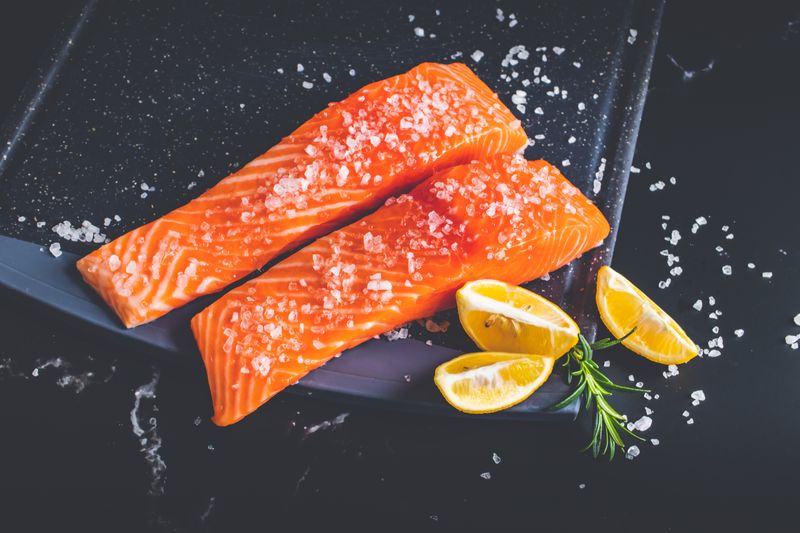
ProstateFoods writes about food, not treatment. Nothing here is medical advice or a claim that any food treats, cures or prevents a disease. Talk to your doctor before changing how you eat or taking a supplement, especially if you take medication or have a health condition. See our medical disclaimer. Photo: Raw pieces of salmon with salt and lemon wedges on a baking tray, via Pexels (Pexels license).
Frequently asked questions
What food is highest in vitamin D?
Cod liver oil, at about 1,360 IU per tablespoon in USDA data. Among regular foods, farmed rainbow trout leads with about 645 IU per cooked 3 ounces, followed by sockeye salmon at about 570 IU.
What are 5 foods high in vitamin D?
Rainbow trout, salmon (fresh or canned), mackerel, UV-treated mushrooms and canned sardines. Fortified milk and plant milks add about 100 to 144 IU per cup, depending on the brand.
How much vitamin D is in mackerel?
About 388 IU (9.7 mcg) per cooked 3-ounce serving of Pacific and jack mackerel in USDA FoodData Central. USDA has no cooked value for Atlantic mackerel; raw Atlantic mackerel is listed at 643 IU per 100 grams.
How much vitamin D should a 70 year old take daily?
NIH lists 600 IU (15 mcg) a day for adults through age 70 and 800 IU (20 mcg) from age 71, counting food, drinks and supplements together. The adult upper limit is 4,000 IU a day. Ask your doctor whether you need a supplement.
Which foods are high in both vitamin D and calcium?
Canned fish with soft bones and fortified drinks. In USDA data, a 3.75-ounce can of sardines in oil has about 178 IU of vitamin D and 351 mg of calcium, and a cup of fortified 2% milk has about 120 IU and 293 mg.
Do eggs have vitamin D?
Yes, a little. One large hard-boiled egg has about 44 IU in USDA data, and NIH notes the vitamin D is in the yolk.